



NEWS LETTER Fresh Story Vol. 40 Jan 2022
This article summarizes news search results obtained using ‘Big Kinds’, a news search service provided by the Korea Press Foundation, and summarizes the latest news reports on ‘Kimchi’.
The search term was 'kimchi', the search target was 'news', and the search term range was 'title', In order to increase the efficiency of the search operation, the scope of the media was divided into metropolitan newspaper, ‘Business magzaine’, ‘broadcasting company’, etc, The scope of the integrated classification items was limited to ‘economic’, ‘society’, ‘culture’, ‘international’, and ‘IT_science’, etc.
The period in which the search target news was announced is from June 18 to Dec1, 2021. Some of the comments included in this article reflect the author's personal point of view and may differ from the official position of the World Institute of Kimchi.
From mid-Jun to Dec 1, there were a total of 2,920 kimchi news reported in the domestic media (Metropolitan papers, Business magazine, and broadcasting companies). Among them, news topics that were reported by a number of medias focused on 'Chinese expression of
To help readers understand, a table was created by randomly selecting representative articles for each topic (Tables 1 to 5), and a brief explanation was attached to the news flow. Articles that could be related to a specific person's political or commercial interests were excluded from the 'Press Case' table, and the title of 'Contributor' was left out.
The expression 'imported' is seen in several articles, but it does not fit the grammar, so it is correct to change it to 'made in foreign countries'. Because it is equivalent to saying “made in Su-Ip”. If you want to emphasize 'import', you can say 'imported kimchi'. In this article, we inform that the expression in the article ‘made in Su-Ip’ has been replaced with ‘imported kimchi’. In addition, some words were quoted according to the standard, and articles that cited incorrectly statistical data were also corrected in the text, but were not revealed one by one.
1) Chinese expression of ‘kimchi’
In Jan of this year, YouTuber Liziqi's kimchi dish video, the controversy over the 'kimchi process' (工程, project) caused by articles and photos about kimchi posted on Twitter by the Chinese ambassador to the United Nations, Zhang Jun, made headlines, and the Chinese expression of kimchi, which appeared in an entertainer's broadcast line, export food labeling, and display of rice balls in domestic convenience store became a problem throughout the first half of the year.
In Jun, the controversy over kimchi's Chinese expression began to ignite again. The start of the problem is that the "kimchi" is expressed as "bao chai" in Chinese subtitles of the scene where BTS members learned how to make kimchi from Jong-won Baek, CEO of The Born Korea, on a live Internet broadcast (NAVER V Live) starring BTS.
In response, the civic group VANK requested the Ministry of Culture, Sports and Tourism (hereinafter referred to as the Ministry of Culture, Sports and Tourism) to revise the Chinese expression of "Kimchi." The Ministry of Culture, Sports and Tourism, in Ordinance No. 427, 'Guidelines for foreign language translation and transcription of public terms,' enacted in July last year, stipulates that "the idiomatic transcription of food names already widely used in China is recognized as it is", and as Chinese translation of kimchi through examples, Pao Chai was adopted.
Since then, articles have been reported that kimchi is translated as Pao Chai in Chinese textbooks for domestic middle and high schools and in Chinese dictionaries of ‘Naver’ and ‘Daum’. In the end, the Ministry of Culture, Sports and Tourism announced on July 22 that the Chinese expression for ‘kimchi ’would be revised and implemented as‘Xinch’. This translation was 'developed' by the Ministry of Agriculture, Food and Rural Affairs in 2013 after collecting opinions from industry and experts, and has been reexamined for its feasibility several times until recently, but it has finally come to light.
Table 1. Press Case-Chinese expression of Kimchi
| Date | Article title | Press | Reporter |
|---|---|---|---|
| Jun 20 | BTS says "kimchi", the subtitles say "Pao Chai"... Naver V app Controversy | JoongAng Ilbo | Seok-hyun Go |
| Jun 21 | Chinese subtitles on the kimchi promotion screen for 'BTS/Jong-won Baek's appearance' Controversy over the appearance of 'Pao Chai' | YTN | Seung-hoon Ji |
| Jun 22 | Because of an unamended ordinance? … 'Pao Chai' subtitles on BTS' 'Kimchi' promotional video | Kookmin Ilbo | Geumju Cheon |
| Jun 27 | Troubled Korean companies under 'anti-China sentiment' | Korea Economic Daily | Hyun-woo Kang |
| Jun 29 | Korean Chinese textbooks translate kimchi into Pao Chai… Vank Modification Request | Segye Times | Chanyoung Kim |
| Jun 29 | Domestic Chinese textbooks mistranslated ‘kimchi → Pao Chai’ | Dong-A Ilbo | Ji-hye Han |
| Jul 8 | Searched for 'kimchi' in Naver and Daum Chinese dictionary and then found ‘Pao Chai' | Chosun Ilbo | Noh Seok-jo |
| Jul 22 | The Chinese transcription for kimchi is 'Shinchi (辛奇)', not 'Pao Chai' (泡菜). | Seoul Economic Daily | Jung Young-hyun |
| Jul 22 | The Chinese transcription for kimchi is 'Shinchi', not 'Pao Chai'... Revision of the Ministry of Culture, Sports and Tourism Ordinance | Hankook Ilbo | Kim So-yeon |
| Jul 25 | Chinese netizens say, "It's just Korean Pao Chai" for kimchi in Chinese 'Shinchi' | Segye Times | Guijeon Lee |
| Aug 5 | “Why is kimchi called Shinchi? Chinese transcription should be withdrawn.” | Kookmin Ilbo | Choi Min-woo |
| Aug 5 | "Why is kimchi 'Shinchi'? Absurd action"... Ministry of Culture, Sports and Tourism 'withdrawal of Chinese transcription' Blue House petition | Asian Economic Daily | Midam Huh |
There was not only a welcome response to the South Korean government's decision to change the Chinese expression for 'kimchi' to 'Shinchi'. First of all, the Chinese expressed their displeasure at the violation of language sovereignty, saying, “How to translate into Chinese is a matter for the Chinese, not for Korea to decide” (Segye Ilbo, July 25, 2021).
In the country, an elder Chinese writer opposed the government's measures and filed a petition for withdrawal from the Blue House, attracting attention. Byung-gi Kim, professor emeritus of the Department of Chinese Language and Literature at Chonbuk National University, said, “In order to easily understand a culture that does not exist in any society or any country, they choose the term closest to their own culture. As the Chinese have always called 'Hanguo pao chai' to clearly reveal the difference between Korean kimchi and their own pao chai, it is most appropriate to write side-by-side the English pronunciation of 'kimchi' in parentheses.” (Kookmin Ilbo, Aug.5. 2021)
Korean entrepreneurs working in China said, "China's National Food Safety Standard (GB) requires all pickled vegetables, including kimchi, to be marked as Pao Chai." If this is not followed, they can't be sold. Sauerkraut, a German pickled napa cabbage, is also sold as Pao Chai in China (Korea Economic Daily Jun 27, 2021) and in China, if ‘kimchi’ is marked with a term other than ‘Pao Chai’, export food cannot be distributed.
The Chinese expression for 'kimchi', which has been legally or customarily used by Chinese people, is 'Hanshi pao chai' or 'Han guo pao chai', and 'cabbage pickles’ is called rabai chai (spicy cabbage). Koreans living in the northeastern part of the China Peninsula are citizens of the People's Republic of China, and their food culture is regarded as a component of Chinese food culture. Korean kimchi is placed in the pickled vegetables (pao chai) category and is called as ‘Hanshi pao chai’(Korean pickled vegetables) to distinguish it from yen chai (pickled vegetables) and jiang chai (Pickled vegetables). This phenomenon is possible because China has comprehensive control over the economy, society, culture, and even ideology of the Korean-Chinese (Korean).
It is a very remarkable event that Koreans complained about the nomenclature of kimchi of superpower China and coined a new term to change it. It is believed that the background of the incident is the national power of the Republic of Korea, which has grown enough to rise to the ranks of advanced countries. However, hoping that it will not stop at ‘spiritual victory’, we recall Lao-tzu’s teaching, ‘Empty your mind and fill your stomach.’
2) Consumption of Chinese kimchi by food-service establishments
Despite the shock of the video of 'Naked pickles' in March, the results of a survey that a number of domestic restaurants still consume imported kimchi from China drew attention of the media. According to the ‘2019 Kimchi Industry Survey’ (Ministry of Agriculture, Food and Rural Affairs), 40.5% of restaurant industries responded that they “used imported kimchi.” (Korea Economic Daily, June 24, 2021) The Korea food service Industry Research Institute also announced on April 20 that the rate of purchasing imported kimchi at domestic restaurants was 43.1%, a decrease of 4 percentage points compared to the previous year (The Kyunghyang Shimbun Jul 4, 2021) The Korea Rural Economic Research Institute also published a report last year that 54% of restaurants in Seoul used Chinese kimchi. (Seoul Shimbun Jul1, 2021)
Table 2. Press Case ? Chinese kimchi consumption by restaurants
| Date | Article title | Press | Reporter |
|---|---|---|---|
| Jun 24 | how cheap... More than half of the kimchi used in restaurants is made in China. | Korea Economic Daily | Jinkyu Kang |
| Jul 1 | Chinese media “Chinese kimchi, good price and quality… Koreans also eat more Chinese kimchi than domestic ones.” | Segye Times | Dong-jun Lee |
| Jul 4 | Despite the stirl of naked kimchi from China... 68% of restaurants "Do not change to domestic product" | YTN | Lee, Ji - Eun |
| Jul 5 | Will all 'naked napa cabbage' pass? Restaurants that did not give up 'Chinese Kimchi' | Hankook Ilbo | Ryu Ho |
| Jul 6 | Hong Kong media "Kimchi birthplace war? Korea uses Chinese products anyway" | Moneytoday | Ji-yoon Lee |
| Jul 7 | Is it possible to have naked kimchi for lunch today? Restaurant that fakes Chinese kimchi 7.5t | JoongAng Ilbo | Seong-bin Im |
| Oct 21 | Kimchi eaten at restaurants, almost half imported | Seoul Economic Daily | Joo-hee Yoo |
| Oct 21 | 4 out of 10 restaurants use only imported kimchi | Kyunghyang Shinmun | Kwang-ho Ahn |
According to the survey results of the Korea Food Service Industry Research Institute, 53.2% of the reasons why domestic restaurants stick to imported kimchi were “the unit cost of domestic kimchi is expensive” and 18.0% answered “The imported kimchi we currently purchased is reliable”. There were no complaints from customers even if they used kimchi” was 17.6%. (YTN Jul 4, 2021) The results of this survey show the reality that restaurant managers' 'quality trust' and visitors' 'non-resistance acceptance' attitude toward imported kimchi are consistently formed.
From Oct of this year, the same safety management standards applied to domestic kimchi manufacturers began to apply to imported kimchi made in China. If this measure, which is applied annually depending on the size of the company, is completed in a few years, the anxiety about the safety of Chinese kimchi made by Korean restaurant managers and visitors will be weakened even more than now. The hygiene problem of Chinese kimchi acts as a kind of non-tariff barrier, maintaining consumer sentiment in favor of domestic kimchi despite the large price difference.
According to the “Food Distribution Yearbook” (Food Journal, 2021), the 2020 average unit price (wholesale) estimates for Korean kimchi and imported kimchi are 3,011 won and 1,055 won per kg, respectively, representing the price ration of 2.85 times. At the retail stage, it is estimated that Korean kimchi is three times more expensive than imported kimchi. When two products with the same quality or the same grade are sold in one market, the economic law of indifference is that they are sold at the same price even if the manufacturers are different. If safety concerns about imported kimchi made in China disappear, this rule will be easier to push on in the domestic kimchi market.
Compared to advanced countries that guarantee business stability by limiting the number of restaurants according to the number of surrounding populations through the restaurant licensing system (total volume system) and the certification system (Meister system), in Korea, where there are few barriers to entry into the restaurant business, in the midst of unlimited competition, most restaurants are defenselessly exposed to the risk of business suspension or closure. If the business environment is not improved, the temptation of imported kimchi for restaurant managers will become more intense.
3) Kimchi trade surplus
Although there were signs of a surplus in kimchi trade in the first half of this year, an article criticizing the deficit for 11 consecutive years was published due to the accumulated amount that was still in the red. In the second half of the year, exports of Korean foods, including kimchi, were generally strong, and the record for kimchi exports was renewed. On the other hand, imports of kimchi fell sharply compared to the previous year, resulting in many articles estimating an annual balance surplus.
Table 3. Press case-Kimchi trade surplus
| Date | Article title | Press | Reporter |
|---|---|---|---|
| Jul 6 | Agri-food exports in the first half of this year were $4.15 billion... all-time high | Munhwa Ilbo | Hae-dong Jo |
| Jul 7 | Korean kimchi, which has captured the taste of the US and Europe, Exports hit a record high | Asian Economic Daily | Hye Sun Im |
| Jul 15 | Imports of kimchi made in China decline for 3rd consecutive month after controversy over ‘naked kimchi’ | Segye Times | Hee-won Kim |
| Jul 26 | Exports of 'kimchi' on the table worldwide, exceed 40,000 tons this year | Financial News | Ji-min Jo |
| Aug 16 | Kimchi imports plummeted by 27% in July... Decline since April | YTN | Byung-han Park |
| Sep 6 | Will the birthplace status be restored? ‘Kimchi trade balance’ to be in surplus for the first time in 12 years | JoongAng Ilbo | Hae-yong Son |
| Oct 12 | Kimchi likely to record a trade surplus for the first time in 12 years... K-food exports increased significantly | Kyunghyang Shinmun | Midup Joe |
| Oct 12 | Kimchi trade balance to be in surplus for the first time in 12 years | Chosun Ilbo | Choong-ryeong Kim |
| Nov 22 | This year, we protect the pride of 'Kimchi birthplace' Prospects for the first time in 12 years | Asian Economic Daily | Hye-sun Im |
According to trade statistics provided by the Korea International Trade Association, kimchi exports from Jan to Oct of this year amounted to $136.11 million, up 14.3% from the same period last year ($119.1 million), but imports were 188.84 million. it decreased by 14.2% compared to the same period last year ($126.91 million). If this trend is maintained for the remaining two months, it is expected that the kimchi trade balance will break out of the 11-year deficit since 2009 and record a surplus.
Although it fell short of 37.6% of the previous year, kimchi exports recorded double-digit growth this year as well, and the import growth rate of 16.4% turned to negative double-digits. The reasons for this include an increase in export unit price, an increase in exports, and a sharp decrease in imports. According to trade statistics, the average export unit price (FOB) rose 4.3% compared to the previous year, while the import unit price (CIF) rose only 1.3%, compared to the same period of the previous year, the growth rate of exports was 9.1%, while the growth rate of imports was -15.0%.
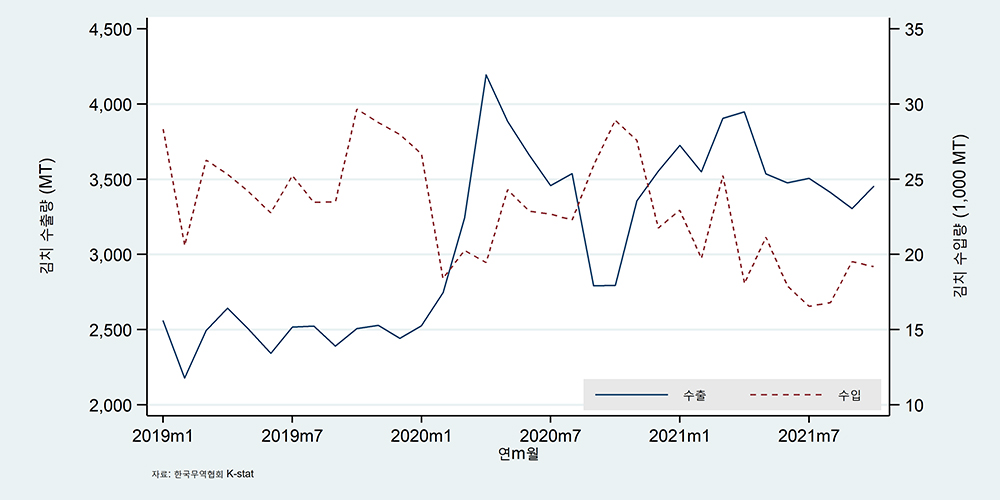
Figure 1. Korea's kimchi trade trend (Jan 2019 ~ Oct 2021)
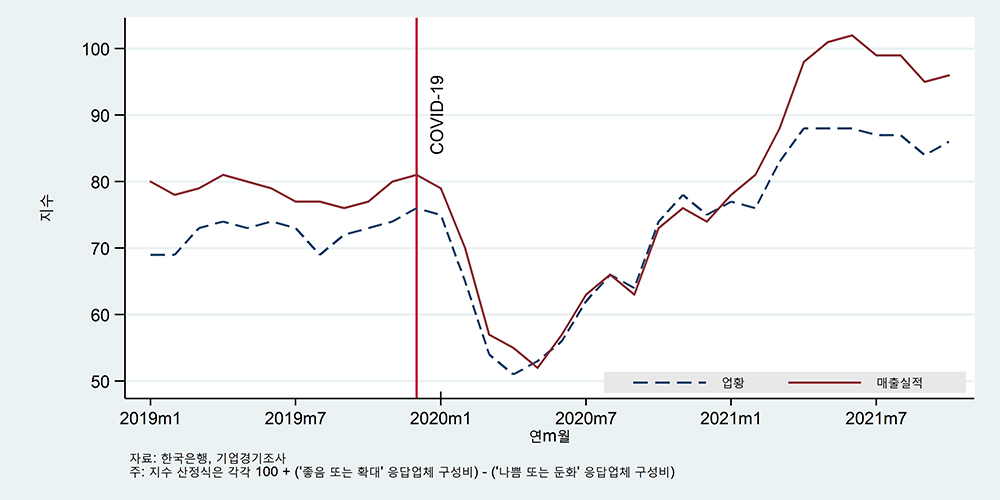
Figure 2. business survey index trend (Jan 2019.~ Oct 2021.)
The number of businesses that introduced the domestic kimchi certification system hosted by the Domestic Kimchi Autonomous Labeling Committee (the Korea Kimchi Association, the Food Service Industry Association, the Franchise Association, the Food Service Federation, and the Korean Food Association) increased from 1,200 at the end of last year to 7,300 this year, more than six times increased (Korea Economic Daily, August 16, 2021), or it seems that anxiety about hygiene of Chinese kimchi, which was amplified in the aftermath of the video of naked pickling, may have affected the decrease in kimchi imports. The media did not point out, but what I would like to add as factors for the decrease in kimchi imports is ‘the calming of the booming economy (or turning it into a downturn)’, ‘explosive increase in the number of corona19 confirmed cases’, and ‘stabilization of napa cabbage prices’.
In one side of the yard of the house, a ceramic bowl large enough for a child to hide in was buried, gimjang kimchi was put in a seal, and one or two heads of kimchi were taken out and eaten from the snowy winter to the following spring. Living in an apartment without a private yard for households required a refrigerator that could replace gimjangdok. As the economy grew, food became abundant, and the uses of the 'refrigerator' diversified, a 'kimchi refrigerator' that had never existed before was introduced. In the early stages, ‘kimchi refrigerator’ mainly contained kimchi. These days, meat, fish, fruits, raw vegetables, beverages, wine, etc. occupy a larger space than kimchi.
From the end of Aug, promotional articles and analysis articles from the three home appliance companies began pouring out about the new Kimchi refrigerator. WINIA Dimchae, which open fire first, has a ±0.1℃ ultra-precise fixed temperature technology, an original underground cooling and top cooling system that directly cools the storage itself, a new aging algorithm that can more than double the antioxidant capacity of kimchi, the 10-kimchi specialty aging mode and optimal storage of wine (Dimchae Bordeaux Special), etc. were intensively promoted.
Table 4. Press Case ? Evolution of Kimchi Refrigerator
LG Electronics introduced the strengthening of artificial intelligence customized storage function (Customized storage of 9 types of kimchi from Korea's leading brands), the ability to multiply the lactic acid bacteria that enhance the taste of kimchi up to 57 times compared to the general storage mode, the indirect cooling method without worrying about frost, the large capacity of 491 liters and the partition wall (Dios Kimchi Toktalk Objet Collection).
Samsung Electronics has developed a 'Kitchen Fit' design that fits perfectly into kitchen furniture without additional construction, super temperature metal cooling technology that maintains a deviation within ±0.3℃, automatic door opening function by touch sensor, 4 doors that can store various ingredients, and Grain dispenser (BESPOKE Kimchi Plus) was emphasized.
With the coming of the gimjang season, the price of napa cabbage, other seasoning vegetables, and even sea salt has risen a lot. The supply of napa cabbage was not smooth due to the spread of a late rainy season and cabbage blight, autumn cold wave, and a decrease in napa cabbage cultivation area, and logistics costs rose due to an unexpected lack of "urea" fueling the rise in gimjang prices. However, contrary to media concerns, there was no " Gimjang chaos" or it was very weak.
Table 5. Press Case ? The rise in gimjang prices
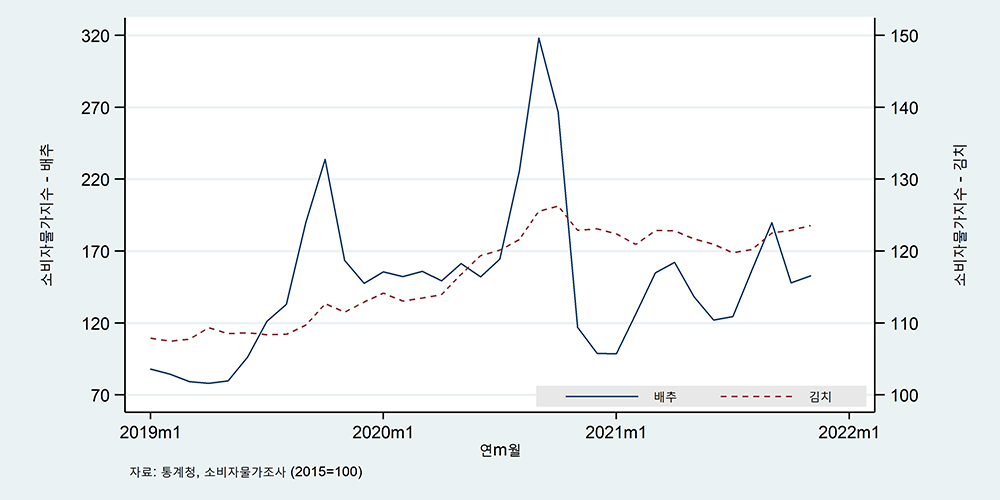
Product kimchi and commercialized gimjang materials act as a buffer to reduce the burden of rising prices for kimchi. As shown in Figure 3. consumer price index trend (napa cabbage, Kimchi, Jan 2019 ~ Nov. 2021)
Writing, Seong-hoon Park, Senior Researcher, Culture Prosperity Research Group,
Looking at
The number of COVID-19 confirmed cases, which was around 500, broke new records several times, including 797 on Apr 23, 1,710 on Jul 30, and 3,273 on Sep 25. Eeun-kyung Jung, Director of Korea Disease Control and Prevention Agency also mentioned the entry of 'the 4th epidemic'. If' distancing' is strengthened for prevention of epidemics, restaurant business will contract and consumption of imported kimchi will also decrease.
From Jan to Oct of this year, the napa cabbage Consumer Price Index (National Statistical Office, 2015 = 100.0) is average 143.2, down 18.9% from the annual average of 176.5 last year. The coefficient of variation also decreased from 0.3557 to 0.1723, indicating that the price fluctuation was not as severe as in the previous year (Figure 3).
If the price of napa cabbage stabilizes and price variability is eased, the number of consumers who make kimchi directly increases. If restaurants make kimchi directly, the demand for imported kimchi will decrease.
Statistics on economic fluctuations in Korea are being used as information that can look several months of the world economy ahead, to the extent that Korea is called "the weather vane of the world economy" (William Pesek). In other words, Korea's economic slowdown (or expansion) is a leading indicator of a global economic downturn (or boom).
Looking at , which shows the trade volume of kimchi, not only kimchi imports but also kimchi exports have been decreasing locally since April. The global re-spread of Corona-19 and the downward stabilization of the domestic and global economy are thought to be the cause of the simultaneous decrease in kimchi imports and exports.
As mentioned earlier, from Oct, the Safety Management Certification Standards (HACCP) began to be applied to imported kimchi made in China. This year, it will be expanded to companies with more than 10,000 tons, from Oct next year to companies with more than 5,000 tons, and from Oct 2023 to companies with more than 1,000 tons. (KBS Sep 29, 2021) In the meantime, the domestic kimchi industry has complained that this is “reverse discrimination” because the same Safety Management Standards has not been applied to imported kimchi made in China. Now, domestic kimchi manufacturers are facing a new phase in which they have to compete on an equal starting line with Chinese kimchi exporters. What will differentiate them? It is noteworthy how the Korean-Chinese war of kimchi in the domestic market will develop in the future.
4) Evolution of Kimchi Refrigerator
Date
Article title
Press
Reporter
Aug 26
Kimchi refrigerator 'Dimchae' new product launched... "Equipped with kimchi aging technology to increase immunity"
Asian Economic
Daily
Hye-won
Kim
Aug 29
LG Electronics, launches kimchi refrigerator with enhanced ‘AI customized storage’
Hankyoreh
Kim Young-bae
Sep 8
Samsung Electronics, launches a new product 'Bespoke Kimchi Plus'... Realization of 'built-in look' without additional construction
Maeil Business
Newspaper
Lee Sang-gyu
Sep 15
Samsung launches a new one-door bespoke refrigerator... “it Increased capacity and equipped with a touch sensor, thereby convenience ↑”
Seoul Economic
Daily
Lee Soo-min
Sep 16
LG stand-type kimchi refrigerator adopts cooling method without worrying about frost
Seoul Economic
Daily
Dongho Kim
Sep 18
Home appliance industry ahead of Gimjang season, 'Great War' for kimchi refrigerator
Asian Economic
Daily
Soo Yeon
Woo
Sep 24
LG Objet Collection 491L maximum capacity kimchi refrigerator launched
Herald
Business
So-hyeon
Joo
Sep 28
Winia Dimchae, introduced a new product 'Dimchae' equipped with a special wine room
Asian Economic
Daily
Heung-soon
Kim
Sep 28
GIMPO people (giving up Gimjang) are increasing... Kimchi refrigerator evolving into a second refrigerator
Chosun Ilbo
Min-jun
Cho i
Oct 4
'Geogeeoikseon' that matches the kitchen color, kimchi and ingredients Soksok 'jack of all trades'
Seoul Shinmun
Seok Ahn
Oct 6
Gimjang season is back... the latest Kimchi Refrigerator ‘Fermentation and New Technology Competition’
Aju Business
Daily
Su-ji Kim
Oct 13
Only store kimchi? The evolution of kimchi refrigerator ahead of Gimjang season
Maeil Business
Newspaper
Yoon-kyung
Bae
Winia Dimchae and LG Electronics seem to have developed a new product, Kimchi refrigerator with an emphasis on ‘improving the kimchi refrigeration function’ and Samsung Electronics on ‘design and convenience’. However, in common, “As more households do not make kimchi or make less kimchi than before, the function as a second refrigerator is being strengthened so that alcoholic beverages and fruits can be stored in the kimchi refrigerator” (Maeil Business Newspaper, Oct 13, 2021). The introduction of wine storage function (WINIA Dimchae), 491-liter capacity and partition wall (LG Electronics), and a 4-door and Grain Dispenser (Samsung Electronics), etc. are typical examples.
According to the National Health Statistics of the Ministry of Health and Welfare, the daily consumption of kimchi per person decreased by 23.8% from 114.4g to 87.1g for 11 years from 2008 to 2019. The intake of napa cabbage kimchi decreased by 25.1% from 79.9g to 59.9g during the same period. This is because there has been a change in the traditional diet centered on rice and kimchi as income levels rise and foods become more diverse. The change in the traditional diet means that the status of kimchi has changed. Kimchi refrigerator is also evolving according to the composition of the food we intake. At the same time, there is a phenomenon that kimchi is alienated from the kimchi refrigerator.
The future of kimchi intake and the future of kimchi refrigerator depend on the status of kimchi in our diet. No matter how healthy a food is, it must be attractive in taste, smell, and appearance to be served on the table frequently. In order to change the status of kimchi, shouldn't there be innovation in the way of eating and kimchi dish?
5) The rise in gimjang prices
According to
According to data from the Korea Price Research Association, the cost of gimjang for four-person households this year needs 355,000 won to 412,000 won, with a year-on-year increase of 8.2% when using traditional markets and 3.2% when shopping at marts. The Korea Price Research Association calculated the cost of gimjang on the premise that napa cabbage 16 heads (about 3 kg per head) and an appropriate amount of auxiliary materials were purchased. Assuming that the yield based on the weight of the napa cabbage is 100%, the weight of the finished napa cabbage kimchi is 48 kg, and the unit price of kimchi made yourself is about 7,400 won to 8,600 won.
Since the price of finished product of gimjang kimchi sold by order through convenience stores is between 6,500 won and 7,700 won per kg, it is on average cheaper to purchase product kimchi without making it yourself. However, housewives labor costs are not included in the Price Research Association data. If labor costs are applied to the labor hours of housewives that are required for all processes of purchasing ingredients, trimming, finishing and putting kimchi into containers, it can be seen that it is absolutely more economical to purchase kimchi without having to calculate.
Date
Article title
Press
Reporter
Sep 25
Napa cabbage price rises again ahead of Gimjang season... 5060 also "Give up kimchi"
Maeil Business
Newspaper
Mi-jin Shin
Oct 20
Even you, napa cabbage in the ‘autumn cold wave’... Afraid to make kimchi this year too.
Herald
Business
Joo-hee
Shin
Oct 25
Napa cabbage prices soared by 25% due to cold·blight and harmful insects... ‘Gimjang chaos’ is coming
Chosun Ilbo
Hye-jin
Song
Oct 28
chives 61%, garlic 28%↑… 'Gimjang Prices' up and down
Seoul Economic
Daily
Hyo-jung
Park
Oct 28
The price of kimchi is also worried... Chives - Salt price jumped by 61%, 42%, and the supply of napa cabbage decreased
Donga Ilbo
Ae-jin Joo
Nov 2
Gimjang costs 23% more than average year... "Prices scarier than COVID"
Moneytoday
Hyo-song
Yoo
Nov 4
Pre-booking 'popular' for pickled cabbage up to 25% cheaper, getting expensive cabbage
Moneytoday
Eun-ryeong
Kim
Nov 6
Cheaper pickled cabbage than napa cabbage" ... distribution industry, pre-order quantity expanding
Asain Economic
Daily
In-kyung
Jo
Nov 6
GIMJANG people? GIMPO people?...’Gimjang kit people'
Herald
Business
Hee-ra
Han
Nov 9
Convenience stores selling 'Gimjang kimchi'... Started selling orders aimed at 'GIMPO people'
Moneytoday
Chan-young Im
Nov 9
"Gave up on Gimjang, but Can't give up on Kimchi"... These days, GIMPO people buy kimchi at convenience stores.
Maeil Business
Newspaper
Yeongdeok
Bang
Nov 10
It's gimjang season, but the price of cabbage is double that of last year... 'GIMPO people' increased
JoongAng Ilbo
Min-jung
Baek
Nov 17
This year’s gimjang is 350,000 to 420,000 won, 8% higher than last year… Retail industry’s ‘gimjang marketing’ heated up
kukmin Ilbo
Sujeong Moon
According to an online distribution company, it is said that “ahead of the gimjang season, the sales of pickled cabbage and kimchi seasoning increased by 125% and 159%, respectively,” and the sales of packaged kimchi also increased by 57% compared to the same period last year from Jan to Oct.”(Herald Business Nov.6, 2021) Convenience stores, such as 7-Eleven, E-Mart 24, etc. take orders for premium brand gimjang kimchi and deliver it to the desired location for free. A 'Gimjang Kit' with pickled cabbage and kimchi sauce has also appeared. You can make 4 to 10 kg kimchi in about 30 minutes, so you can experience gimjang conveniently without knowing how to make kimchi.
The traditional custom of gimjang made by villages or large families is gradually disappearing, and more and more consumers are relying on the market to purchase product kimchi or semi-processed kimchi ingredients. Human relationships, emotions, manners, and tools surrounding kimchi making and consumption have evolved to fit the current socio-economic structure, forming a new kimchi culture.

World Institute of Kimchi

