



NEWS LETTER Fresh Story Vol. 37 Jul 2021
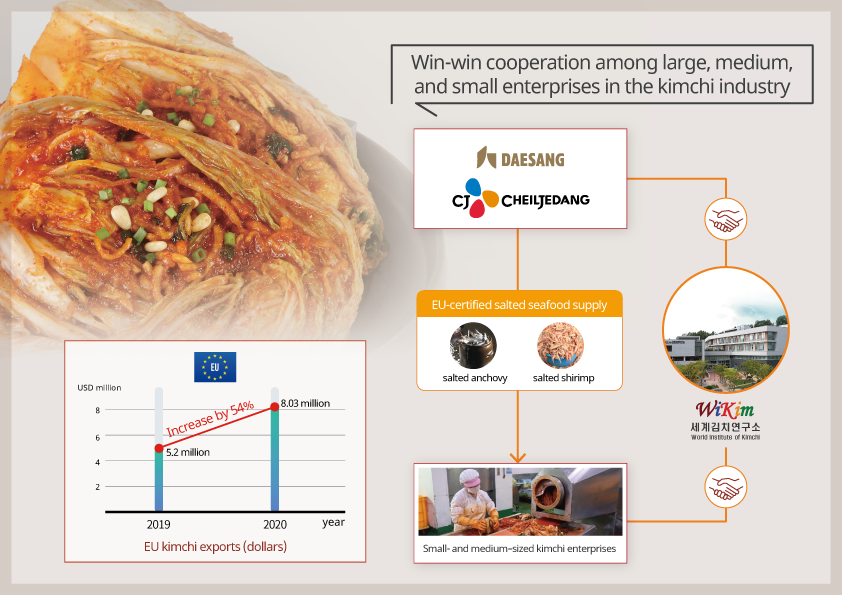
In response to the difficulties of small- and medium-sized kimchi manufacturers following the revision of the EU composite products import regulations, WiKim has prepared a plan to support the supply of EU export–certified salted seafood through win-win cooperation with Daesang Corp. and CJ CheilJedang Corp.
Last year, EU kimchi exports reached USD 8.03 million, only 5% of the total export market, but are rapidly emerging as a new kimchi export market, with kimchi exports in the EU region rising more than 54% year over year because of the widespread interest in kimchi amid the Korean Wave and COVID-19.
※ EU kimchi exports: (2020) USD 8.03 million, (2019) USD 5.2 million, increased by 54.3% year over year
However, EU composite products import regulations have recently been revised, and for composite products that contain even trace amounts of animal materials, suppliers must submit a certificate associated with EU export approval of raw material manufacturing facilities during the customs clearance. In the case of kimchi, salted seafood and animal raw material are used, so companies that export kimchi to the EU region must submit the certificate.
Meanwhile, the companies approved for EU export about salted seafood for kimchi are Daesang Corp. and CJ CheilJedang Corp. Except for these two, most of the producers of salted seafood for kimchi have not been approved for EU export, making it difficult for small- and medium-sized kimchi enterprises to export kimchi.
On Jun. 15th, WiKim invited officials from kimchi enterprises and salted seafood companies to hold “The 1st Technological Exchange Conference 2021” under the theme of solutions for kimchi exporters according to revision of EU composite products import regulations. In the conference, WiKim listened to the difficulties of small- and medium-sized kimchi enterprises and found solutions following the revision of EU regulations.
Most salted seafood manufacturers face financial constraints, and it is not easy for small- and medium-sized kimchi manufacturers to afford the time and cost to certify EU composited products. Thus, they hoped to export kimchi with salted seafood provided from large companies already certified and receive knowledge on vegan kimchi recipes and alternative ingredients of salted seafood from WiKim.
So, WiKim proposed to Daesang Corp. and CJ CheilJedang Corp., which are equipped with the EU-certified salted seafood production lines, to supply the EU-certified salted seafood to small and medium-sized kimchi manufacturers in win-win cooperation between large and small companies. Although the technology and system are what they have worked hard for to export their kimchi, the two companies responded positively to the proposal.
Currently, Daesang Corp. and CJ CheilJedang Corp. are conducting sample tests to provide small- and medium-sized kimchi enterprises with EU-certified salted seafood aiming to export kimchi to the EU. They said that they will actively cooperate to provide sufficient salted seafood to all enterprises wishing to export to the EU.
We hope that this win-win cooperation model will drive soaring export demand in the EU market since COVID-19, and Korean kimchi will be firmly established in the global market.
As a result, considering the grace period for revising the EU complex food import regulations, the concerning suspension of EU exports is expected to be minimized.


- World Institute of Kimchi, 86, Kimchi-ro, Nam-gu, Gwangju, 61755, Republic of Korea / TEL. +82.62.610.1700